Home › Road, Street, and Municipal Paving
Partner with a reliable crew for road paving in Tuscaloosa, AL. We construct and resurface streets, subdivision roads, and municipal routes with proper grading, drainage, and smooth asphalt to handle everyday traffic and weather.
Precision Asphalt Tuscaloosa provides professional road paving throughout Tuscaloosa, AL, Alabama and the surrounding area. Our licensed, insured crew delivers safe, clean, on-time work with a free estimate before anything begins. Call (205) 843-7673 or request your free quote.
Road paving in Tuscaloosa that is built for real traffic and real weather
If you manage roads or streets in Tuscaloosa, you already know our traffic and weather are tough on pavement. Between loaded dump trucks headed to job sites, student traffic around the University, and hot, humid summers that hit 95 degrees, a road that looks fine on day one can ravel, rut, and crack fast if it was not built right.
Precision Asphalt Tuscaloosa focuses on public roads, neighborhood streets, and municipal paving that actually holds up in West Alabama conditions. That starts with listening. We look at what you need the road to do (handle school pickup lines, industrial truck routes off I 20/59, subdivision traffic, or emergency access for fire trucks) and then we match the pavement design to that use instead of applying a one size fits all approach.
We work with city and county staff, HOAs, property managers, and private developers anywhere in the Tuscaloosa area. That includes Tuscaloosa, Northport, Cottondale, Coker, and out toward Lake Tuscaloosa. Whether you are rebuilding a failed street, adding a turn lane, or overlaying a worn section to buy another 10 to 15 years of life, we will walk the site with you and spell out what is really needed, not just what is easiest to sell.
Because we work here every season, we know how our clay soils hold water, how afternoon thunderstorms can hit in five minutes, and how temperature swings from winter mornings to afternoons affect compaction. We plan the work around that local reality so you get smoother roads, fewer callbacks, and fewer complaints from drivers and residents.
How we build durable roads, streets, and municipal pavement
Good road paving is a process, not just spreading blacktop. Here is how Precision Asphalt Tuscaloosa usually approaches a typical road or street project.
1. Evaluation and design
We start with a visual inspection, then we check cross slopes, drainage paths, and existing base strength. On heavier use roads we may recommend core samples or proof rolling with a loaded truck to see how the base responds. Based on traffic type (passenger cars versus garbage trucks or log trucks), we size the asphalt thickness and mix grades. Residential streets might get 2 lifts with a finer surface mix, while collector roads may get 3 lifts with a stronger base course.
2. Drainage and base preparation
Most premature road failures in Tuscaloosa are water related. We shape the subgrade to shed water, add or clean out ditches, and cut relief swales where needed. If the soil is soft, we may undercut and replace poor material with crushed stone, use geotextile fabric to stabilize wet clay, or cement treat the subgrade. We then place and compact graded aggregate base (GAB) in controlled lifts using vibratory compactors and steel drum rollers.
3. Asphalt placement and compaction
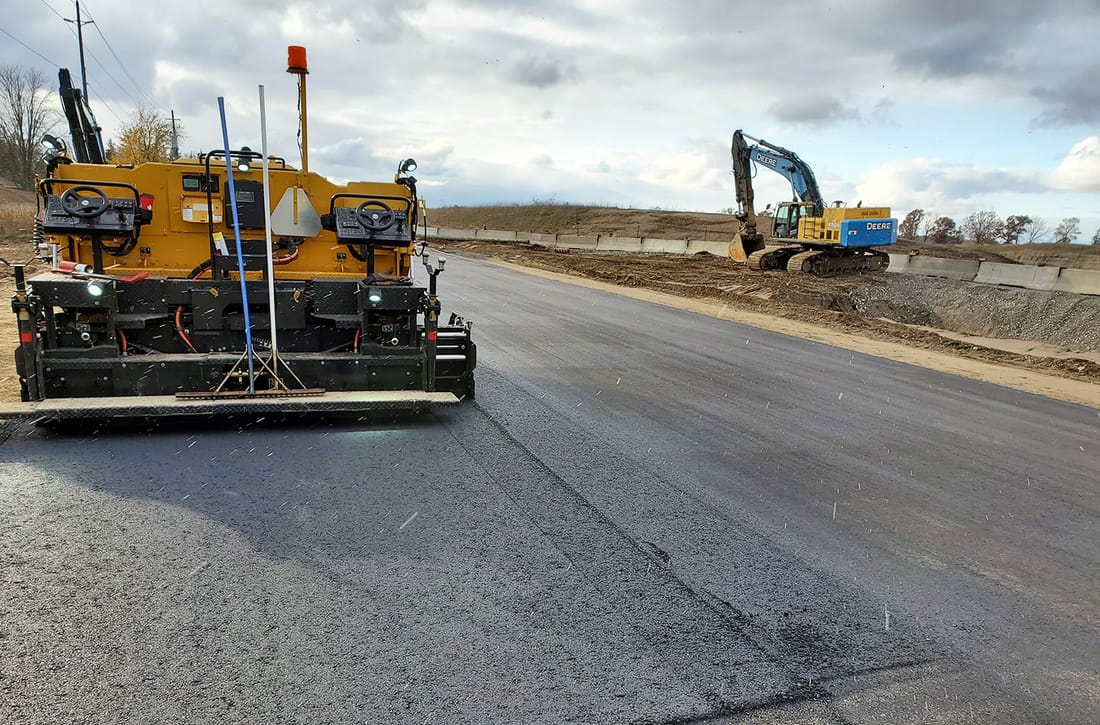
We typically use an asphalt paver for roads and streets, which gives a consistent mat thickness and smoothness. Mixes are delivered from local plants so they arrive at the correct temperature. Our crew checks that temperature, spread rate, and joint quality throughout the job. We use a breakdown roller while the asphalt is hot, followed by intermediate and finish rolling, so final density meets or exceeds typical municipal specs. This density is what provides real strength and long term resistance to rutting.
4. Tie ins, transitions, and details
Good municipal paving lives or dies in the details. We carefully match elevations at driveways, side streets, and ADA ramps so water does not pond and drivers do not feel a sharp bump. Manholes are raised to final grade, not left dipped or crowned. We feather transitions from old pavement to new so the joint does not become a crack line in a year.
5. Striping and traffic control
Once the asphalt cools and cures enough to accept paint, we restripe center lines, edge lines, crosswalks, and stop bars as required. If your municipality uses thermoplastic markings at major intersections, we coordinate that timing so the road can reopen with clear guidance for drivers and pedestrians.
Your material and design options for local road paving
Different streets in Tuscaloosa need different designs. Precision Asphalt Tuscaloosa walks you through the tradeoffs so you are not just picking a price number but choosing a structure that fits your budget and expected use.
Full depth asphalt vs overlay
A full depth asphalt road starts at the subgrade and adds base stone plus multiple asphalt lifts. This is ideal for new subdivisions or for older streets that have severe base failure, repeated potholes, and alligator cracking. It costs more up front but usually gives the longest life.
An asphalt overlay is placed on top of an existing road, typically after milling off 1 to 2 inches to remove ruts and create a good bonding surface. This is a great fit for streets that are tired but not structurally failed. In Tuscaloosa, we often mill and overlay busier corridors and neighborhood collectors to reset the surface and ride quality without rebuilding from scratch.
Mix types and thickness
We adjust the asphalt mix to the application. On low speed subdivision streets, we often specify a fine graded surface mix that provides a smoother, quieter ride. On industrial park or truck routes we prefer a coarser, high stability mix that resists shoving and rutting under braking trucks.
Thickness matters too. A light duty cul de sac might use 2.0 to 2.5 inches total asphalt over a solid base. A street that sees school buses or service trucks may need 3 to 4 inches, placed in multiple layers. Those extra inches are not sales padding, they are the structural strength that keeps your road from deforming when loaded.
Sealcoating and preservation
For some municipal systems, we help set up preservation plans. That can include crack sealing as soon as working cracks appear and sealcoating low speed streets to protect against UV and moisture. In our hot Tuscaloosa summers, unprotected asphalt oxidizes faster, becomes brittle, then cracks more easily. A modest preservation budget often saves major reconstruction costs later.
What affects cost and schedule for Tuscaloosa road paving
Road paving budgets are always tight, so we are transparent about what drives cost and how you can control it.
Key cost drivers
Base condition: If your existing road base is solid, we can often mill and overlay. If the base is pumping water and mud when trucks drive across it, we need to stabilize or rebuild, which raises cost but prevents wasting money on an overlay that will fail.
Traffic loading: Streets that handle garbage trucks, school buses, or industrial traffic need more robust sections and upgraded mixes. It is cheaper to build for the real load now than to patch rutting every summer.
Drainage improvements: Adding pipes, flumes, curbing, or ditching affects budget but is often what saves your new pavement from early failure. We will show you where drainage work is optional and where it is absolutely necessary.
Project size and phasing: Mobilizing equipment for one short block costs almost as much as mobilizing for half a mile. When possible, grouping multiple streets or phases together can improve unit pricing.
Scheduling around Tuscaloosa weather and traffic
Our paving window in West Alabama is wide, but not unlimited. Asphalt compacts best when the ground and air temperatures are warm enough. In cooler months we often pave during the warmest part of the day and tighten our haul distances so the mix does not cool too quickly.
Summer brings heat and pop up storms. We watch radar constantly and plan production so we are not laying fresh asphalt right before an afternoon downpour. For school zones, downtown streets, or routes near the University, we coordinate around class changes, events, and rush hours to reduce disruption. For residential neighborhoods, we often schedule work mid morning to mid afternoon so residents can get out for work first.
Permits and coordination
For true municipal projects we follow your existing specs and coordination processes. For HOAs and private roads that connect to public streets, we help you understand when permits or coordination with the city or county engineering department might be required, for instance, if changing drainage patterns or tying into existing curb and gutter.
How Precision Asphalt Tuscaloosa works with cities, HOAs, and developers
Public and semi public roads affect everyone who lives, works, or studies in Tuscaloosa, so communication is as important as the asphalt itself. We tailor our approach based on who is responsible for the roadway and who uses it.
For municipalities and public agencies
We are comfortable working under formal bid documents, standard specs, and inspection requirements. Our crews expect density testing, asphalt tickets, and field adjustments. We keep daily logs that note production quantities, areas paved, weather, and any field changes so your records stay clear. If you are dealing with citizen complaints on a failing street, we can join you for site meetings and explain the options and expected service life in plain language.
For HOAs and private streets
Many neighborhoods north of the river, along Highway 69, and around Lake Tuscaloosa have privately maintained streets. We help HOA boards understand whether their roads are still structurally sound and just need resurfacing or whether underlying base problems are starting to show. We can break a long term plan into phases, for example, mill and overlay the worst loop this year, crack seal and patch secondary streets, and plan for a full overlay of the rest in 3 to 5 years.
For developers and commercial projects
If you are building a new subdivision, retail center, or industrial site, we can coordinate with your engineer to value engineer the road sections where appropriate. Sometimes a small change in base depth or asphalt layer thickness can save cost without sacrificing performance. Getting the timing right between utility installation, curb placement, and final lift paving is critical so new pavement is not cut and patched before it ever sees traffic.
No matter who the client is, Precision Asphalt Tuscaloosa makes sure you have a simple, clear scope of work in writing, a realistic schedule, and a point of contact who will answer the phone while the job is underway. That way your road, street, or municipal paving project moves from planning to completion with fewer surprises and a finished surface you can stand behind.